
Fewer exploitable misconfigurations
Apply least-privilege IAM, managed secrets and secure-by-default infrastructure as code so common cloud misconfigurations are caught before they reach production.
Cloud & DevOps
Integrate security into every deployment and engineer the reliability of a mature SRE practice—least-privilege access, managed secrets, observability and automated recovery built around your production systems, not bolted on after an incident.
Stronger systems through secure operational practices.
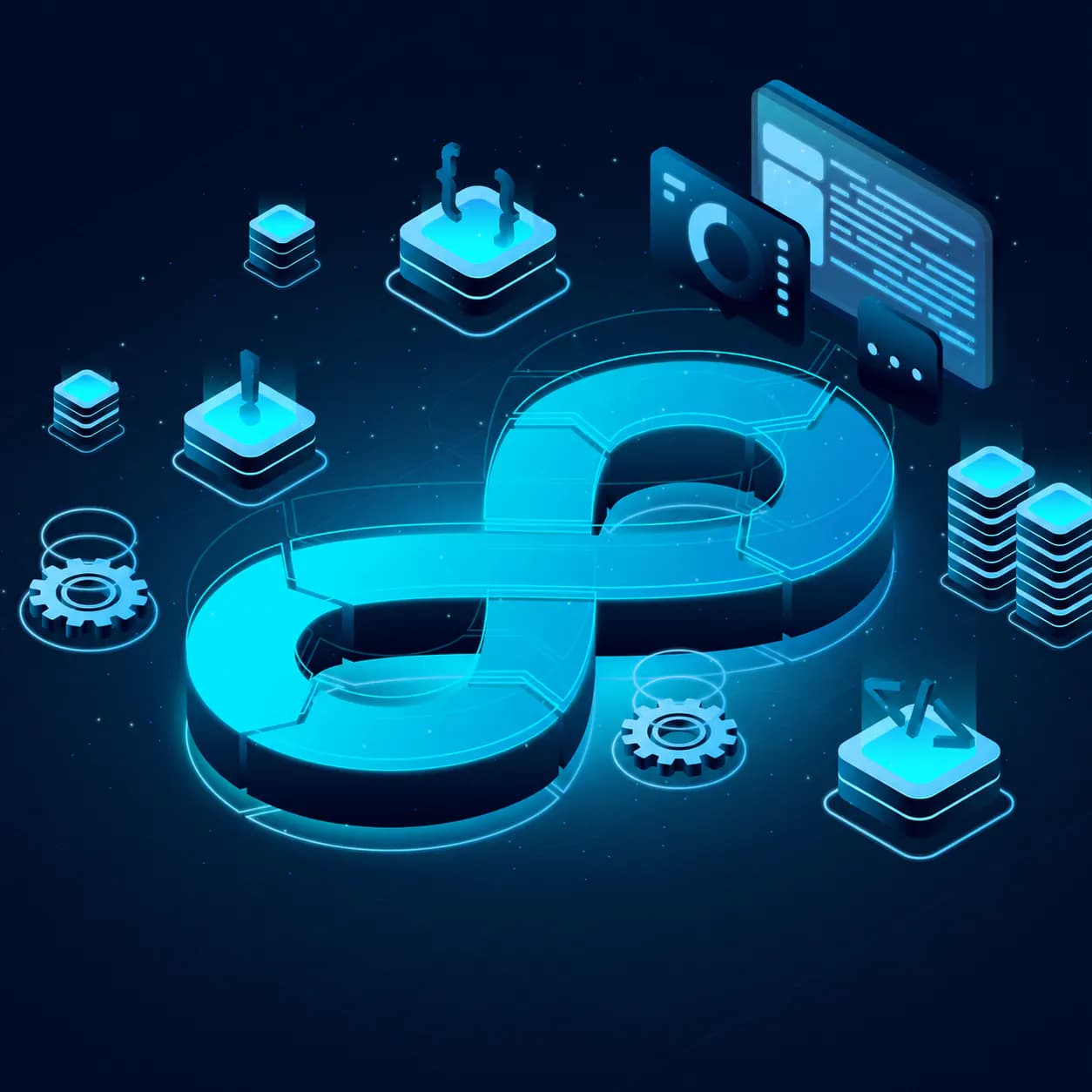
Quick answer
DevSecOps services embed security controls—least-privilege access, secret management and automated scanning—directly into your CI/CD pipeline and cloud infrastructure, instead of reviewing security after release. Integr8e pairs this with site reliability engineering practices—observability, defined SLOs and tested recovery—so systems stay both secure and dependable as they scale.
Business outcomes
Integr8e approaches security & reliability as a business capability—not an isolated technical task. Priorities stay connected to the users, operations and results behind the work.
Apply least-privilege IAM, managed secrets and secure-by-default infrastructure as code so common cloud misconfigurations are caught before they reach production.
Add SAST, dependency scanning and policy checks directly into CI/CD so vulnerabilities are caught in code and pull requests instead of after release.
Instrument production systems with observability, alerting and defined SLOs so incidents are found and resolved in minutes, not discovered by customers.
Design for graceful degradation, automated failover and tested backup and disaster recovery instead of assuming infrastructure won't fail.
Maintain logging, access reviews and configuration history that stand up to SOC 2, ISO 27001 and customer security questionnaires.
Right-size infrastructure and reserved capacity without loosening access controls or skipping recovery testing to save budget.
What we deliver
One connected team covers the decisions and delivery work needed to move from uncertainty to a dependable outcome.
Embed SAST, dependency and secret scanning, and policy-as-code checks into CI/CD so security is enforced automatically on every build and pull request.
Apply least-privilege IAM, role-based access and managed secrets vaults across cloud accounts, services and CI/CD credentials.
Implement metrics, logging, tracing and alerting tied to defined SLOs and error budgets so teams see degradation before customers do.
Design automated backup, multi-region failover and tested recovery runbooks against agreed RTO and RPO targets.
Continuously assess AWS, Azure and Google Cloud configuration, network exposure and IAM permissions against known misconfiguration patterns.
Produce access logs, change history and control evidence mapped to SOC 2, ISO 27001 and customer or regulatory security reviews.
Is this the right fit?
Not every challenge needs the same team or solution. We start by testing the business case, current constraints and fastest credible route to value—then recommend a scope that fits the evidence.
Delivery architecture
The plan adapts to your context, while short feedback loops and visible milestones keep the engagement controlled.
Baseline current IAM, secrets, network exposure, observability and recovery posture against real production risk, not a generic checklist.
Define security gates, SLOs, alerting thresholds and recovery targets before changing pipelines or infrastructure.
Implement policy-as-code, secret management and CI/CD security checks alongside infrastructure as code with least-privilege defaults.
Add observability, alerting and incident response runbooks tied to the SLOs and error budgets agreed in design.
Run failover drills, review access and findings, and continuously tighten posture using production evidence.
Technology context
We select platforms against security, scale, team fit, integration needs and the full cost of ownership.
Frequently asked questions
Need an answer specific to your environment? Share the context and our team will help you identify a practical next step.
DevSecOps services embed security controls—least-privilege access, secret management and automated scanning—directly into your CI/CD pipeline and cloud infrastructure, instead of reviewing security after release. Integr8e pairs this with site reliability engineering practices—observability, defined SLOs and tested recovery—so systems stay both secure and dependable as they scale.
DevSecOps focuses on embedding security into the development and delivery pipeline—scanning, access control and secret management applied to every build. SRE applies software engineering discipline to operations—defining SLOs, error budgets, observability and recovery targets so production systems stay reliable. Integr8e delivers both together because secure pipelines and reliable operations depend on the same underlying access, automation and monitoring foundation.
Security testing—penetration testing, vulnerability assessment—finds exploitable flaws in an application or API at a point in time. DevSecOps and reliability services build the ongoing infrastructure—pipeline security gates, least-privilege access, observability and recovery—that keeps systems secure and available between those tests. Most clients use both: testing validates the application, DevSecOps and SRE practices protect and stabilise the platform it runs on.
Cost depends on the number of cloud accounts and environments in scope, the maturity of current CI/CD and IAM, and whether disaster recovery and compliance evidence are included. Integr8e assesses your current posture first and provides a fixed estimate rather than a generic per-environment rate.
A focused engagement covering one pipeline and its supporting cloud environment typically takes three to six weeks. Programmes spanning multiple accounts, legacy infrastructure or compliance certification take longer. Integr8e confirms timing after assessing current IAM, pipeline and observability maturity.
Yes. Integr8e assesses your existing cloud accounts, IAM structure, CI/CD tooling and observability stack first, then designs security and reliability improvements around what's already running rather than requiring a rebuild.
Engagements can be aligned to SOC 2, ISO 27001 and GDPR, with access logging, change history and control evidence produced as a byproduct of the pipeline and infrastructure work—not a separate audit exercise bolted on afterward.
Integr8e can provide monitoring, on-call support, incident response and continuous hardening after launch, matched to how business-critical the system is. Recovery runbooks and failover paths are tested before launch, not written for the first time during an incident.
Start with the outcome
Tell us what needs to change, who it affects and where the current approach falls short. We'll help shape a sensible next step.
[email protected]


